

Technical Game Designer
Specializing in architecting scalable gameplay systems and designer-facing tools. I’ve been bridging high-level design vision with robust C# implementation in Sworn.
Systems & Tools Engineer
As Technical Game Designer, I’ve been dedicating in building systems and editor tools that helps designers and artists to prototype and create contents, rapidly boosting development lifecycle.
Skill Tree Designer
In Sworn, players can interact with Merlin and Nimue to access the Skill Tree menu and Weapon Upgrade menu in order to leveling up their character.
The Problem: With a few iterations of the meta progression design, we found that the process of design - prototype - test was extremely time consuming. It’s necessary to build a system to help designers to rapidly iterate on ideas. After the main direction of the design was nailed, I was responsible to design and make this system to automatically implement branching meta upgrades without letting designers to touch code.
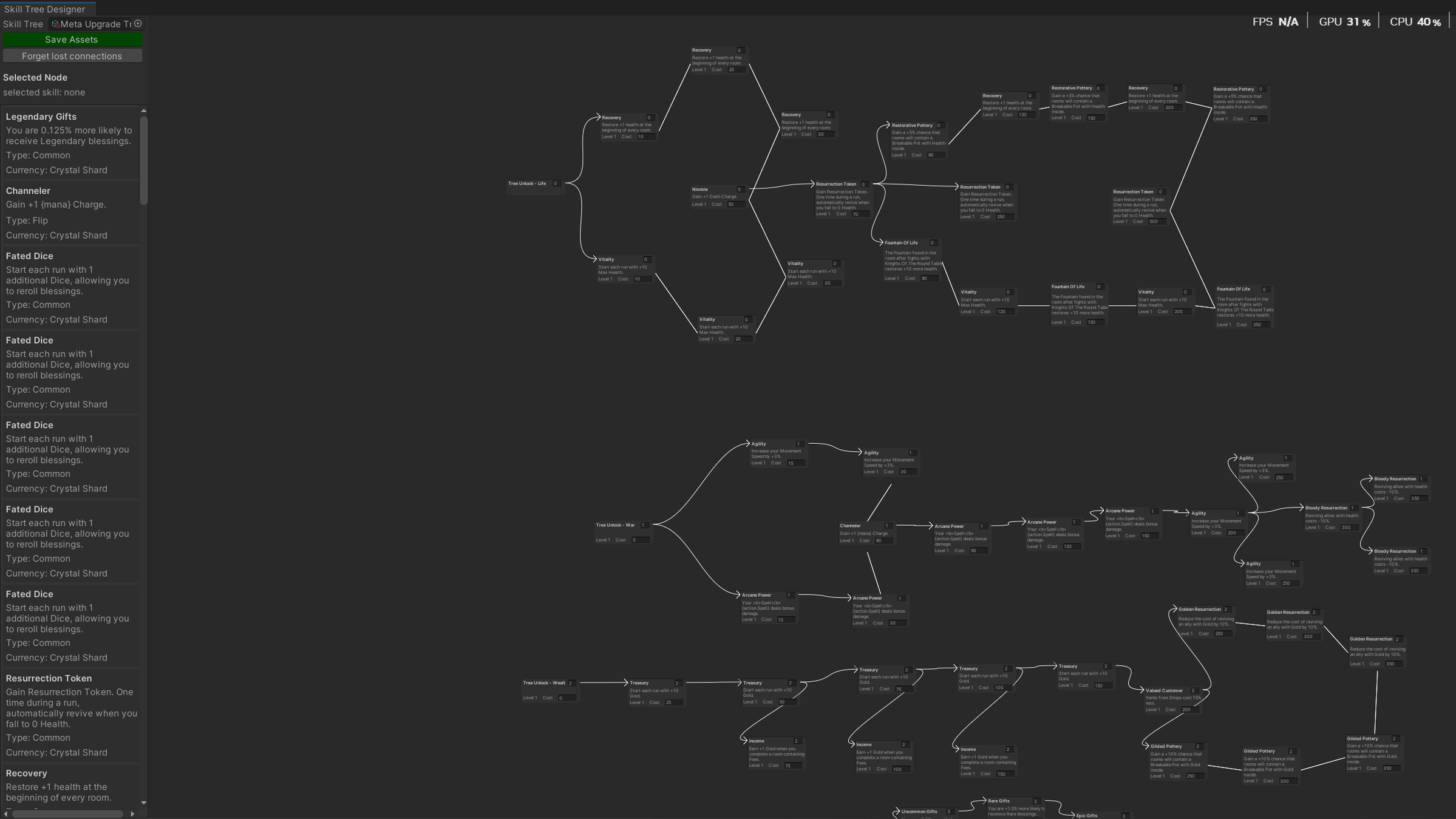
The Technical Solution: Built a custom Unity Editor tool for designers to map complex skill tree structures via an intuitive, drag-and-drop node interface.
Automated Serialization: Engineered the system to save all visual node connections and logic directly into ScriptableObject data assets, allowing designers to save and iterate on different versions.
One-Click UI Synchronization: Bridged the gap between backend data and frontend visuals by implementing a system that instantly reads the updated ScriptableObjects and dynamically reconstructs the UGUI layout.
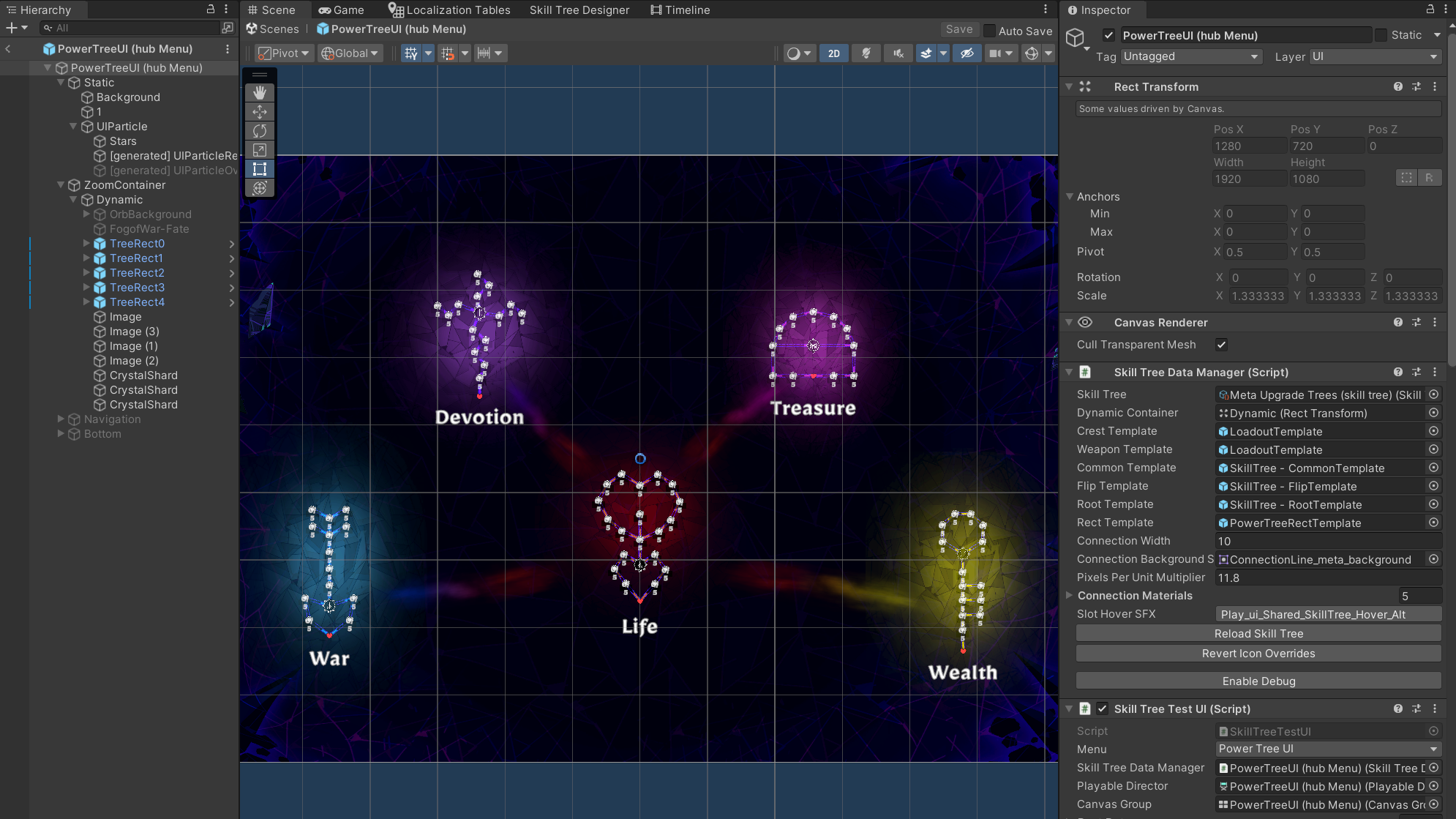
The Result: Eliminated the friction between design and engineering. By allowing designers to independently build, test, and iterate on skill trees directly in-engine, the tool greatly improved cross-departmental efficiency and freed up critical engineering resources.
Combat Design & Development
I was involved in a variety of design and implementation about combat experience including enemies and bosses. Specifically, Lady Kay and Sir Dagonet are the typical bosses that I was mainly responsible for, which both earned favor among players.
Boss: Lady Kay
Most bosses in Sworn favor ranged combat. Lady Kay was specifically designed to reward melee players, utilizing a Shield Duality system that encourages players to move around her to deal effective damage or focus on breaking her shield.
State - Shield On: Defensive & Tanky.
The boss gains high mitigation with the shield blocking any damage coming from front or side. All attacks in this state come from the shield which both defend and attack at the same time. Meanwhile, to balance the difficulty as the first boss in the game, the attacks are designed to be obvious and easy to understand.State - Shield Off: Swift & Aggressive
Without the shield, the boss moves a lot faster and being more aggressive by chasing players or large AOE attacks. However, players can deal a great amount of damage to the boss due to the lack of protection from the shield.
Key Technical Mechanics
To switching between the dual states, a manager script is developed to listen to the shield health to swap animation sets, movement attributes and manipulate the behavior designer state. The shield hurtbox is marked and inserted in the ability system, where all the damage coming from a certain angle in front of the boss are counted as the damage to the shield.
Boss: Sir Dagonet
Sir Dagonet is designed as a "Positioning Check." Utilizing a Hook-and-Cleaver kit, he forces players to constantly manage their spatial awareness while navigating a hazardous, trap-filled arena.
Health-Based State Evolution
Sir Dagonet features a three-phase progression system designed to ramp up mechanical complexity as his health depletes. He begins (100%–70%) with a baseline of two light and two heavy attacks to establish the combat rhythm. Below 70%, he unlocks an expanded move set with new attacks and complex combos. In his final Rage Mode (<35%), the encounter shifts to maximum aggression, utilizing rapid attacks, increased environmental hazards, and larger AOE attacks to strictly pressure player positioning.
Key Technical Mechanics
Dynamic Trap Spitting: Sir Dagonet’s "Belly Face" acts as a projectile launcher for destroyable traps: Firework Barrels (AOE), Goo Balls (Slowing), and Poison Rats (Poison Cloud). These traps are unlocked along the Boss health change.
The Hook: This is the only enemy attack in the game that triggers a full player-control override (Stun/Pull), adding more variety to the overall game experience.
Technical Implementation: Developed state machine transition in Behavior Designer based on boss health to handle attack unlocks in the combat loop.
Thematic Design
Visual Narrative: Translated his "Mad Fool" persona into a "Soulless Monster" design. The "Belly Face" serves both a thematic and functional purpose, providing a clear visual signiture for his trap-spitting mechanics.
Interactive Gameplay System
I’ve worked on a variety of interactive feature or UX systems. Crafting modular, easy to use gameplay systems allows the team to save time expanding gameplay contents and build playful interactive experience.
Potion System
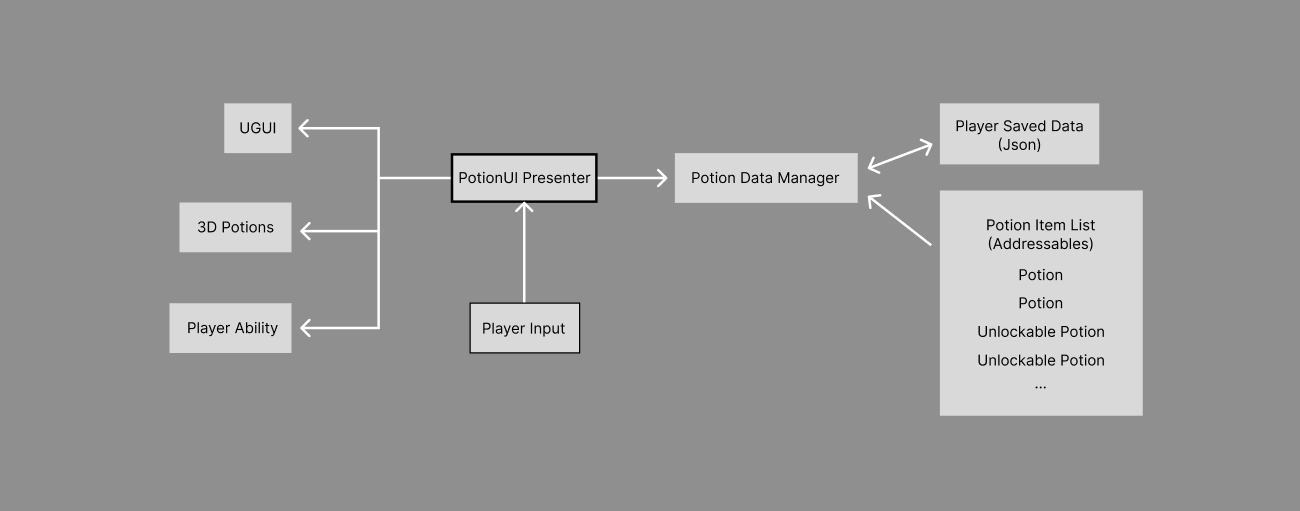
Architected a highly scalable, data-driven Potion and Crafting system using Unity ScriptableObjects and Addressables.
Designed a polymorphic data structure that empowered the design team to create and balance new consumable types, resource costs, and progression unlocks entirely code-free.
Integrated asynchronous asset loading via UniTask to maintain strict performance budgets.
Built a 2D & 3D cinemachine driven UI stage to provide seamless, high-fidelity player feedback during interactions.
Emote System
Architected a highly scalable, event-driven Emote system utilizing a Modified MVP (Model-View-Presenter) pattern to strictly decouple persistent gameplay state from UI logic.
Engineered a data-driven pipeline where new emote assets, PlayableDirector timelines, and metadata can be integrated entirely via ScriptableObjects and Addressables without requiring new code.
Implemented the Observer pattern using C# delegates to create a reactive, high-performance UI.
Utilized UniTask to manage asynchronous 3D asset instantiation, ensuring zero main-thread blocking during complex visual representation.