

Gameplay Development & System Architect
Specializing in high-performant gameplay and UI system architecture, data-driven systems, and custom editor tools. Proven track record of engineering decoupled, event-driven frameworks utilizing Unity Addressables, UniTask, and ScriptableObjects to build scalable and maintainable systems in commercial titles.
Systems & Tools Engineer
As Technical Game Designer, I’ve been dedicating in building systems and editor tools that helps designers and artists to prototype and create contents, rapidly boosting development lifecycle.
Skill Tree Designer
In Sworn, players can interact with Merlin and Nimue to access the Skill Tree menu and Weapon Upgrade menu in order to leveling up their character.
The Problem: With a few iterations of the meta progression design, we found that the iteration process was extremely time consuming. It’s necessary to build a system to help designers to rapidly iterate on ideas without too much burden on the engineering side.
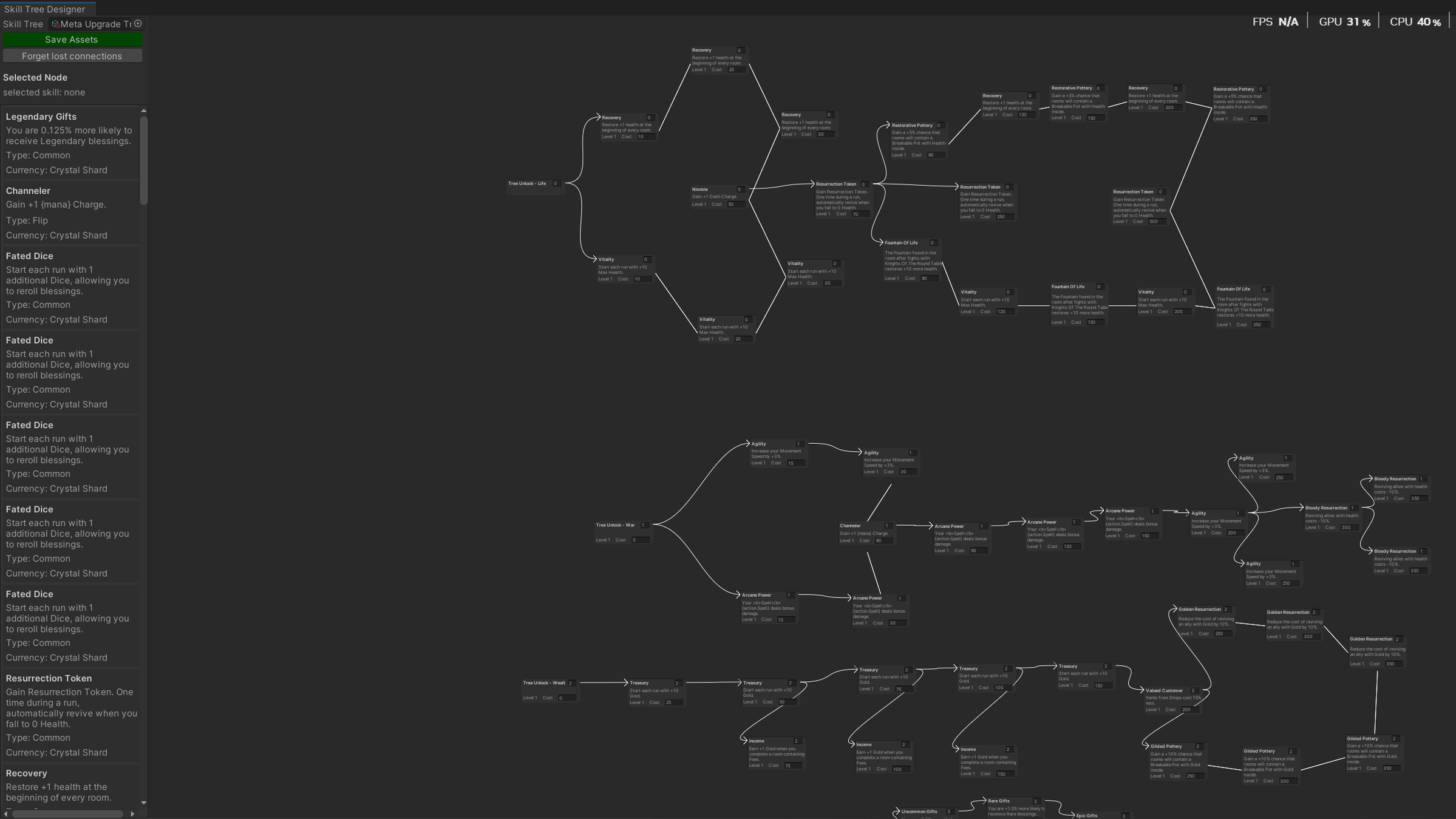
The Technical Solution: A custom node-based Unity Editor tool was built for designers to prototype complex skill tree structures via an intuitive, drag-and-drop node interface.
Automated Serialization: Engineered the system to save all visual node connections and logic directly into ScriptableObject data assets, allowing designers to save and iterate on different versions.
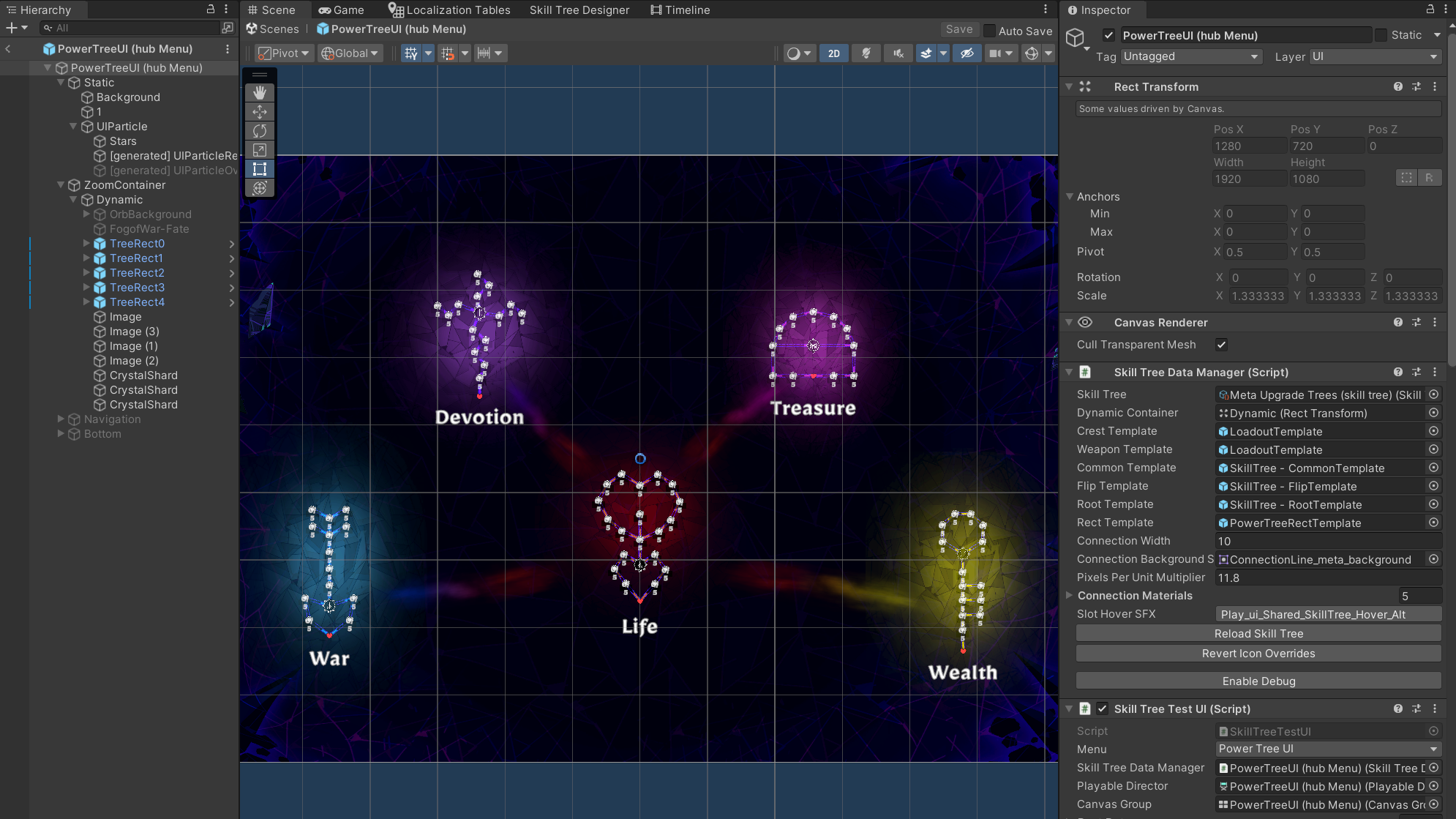
One-Click UI Synchronization: Bridged the gap between backend data and frontend visuals by implementing a system that instantly reads the updated ScriptableObjects and dynamically reconstructs the UGUI layout.
The Result: Eliminated the friction between design and engineering. By allowing designers to independently build, test, and iterate on design ideas directly in-engine, the tool significantly improved team efficiency and freed up critical engineering resources.
Level Designer
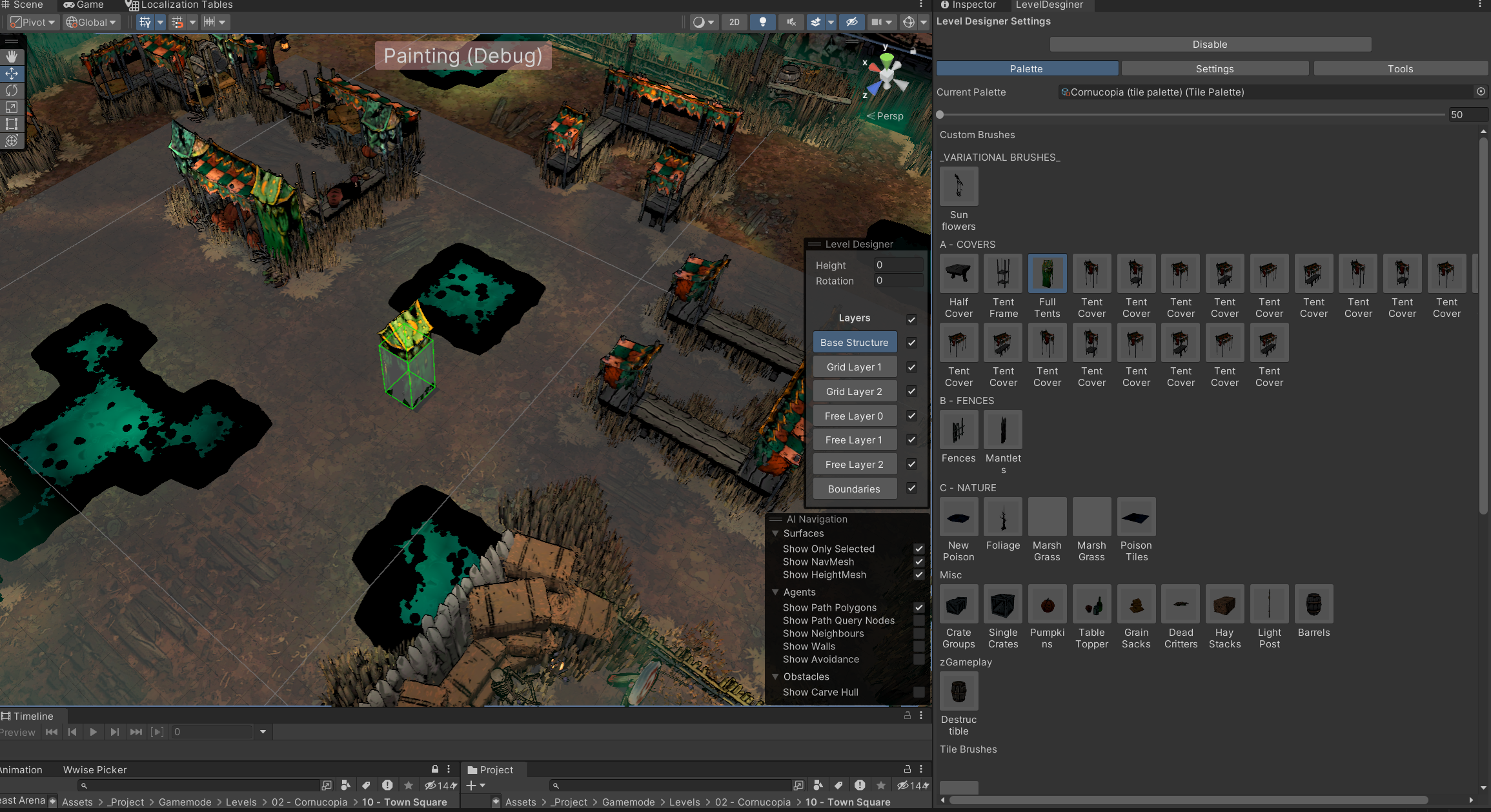
A grid-based Level Designer tool was developed to quickly design and populate levels with minimum effort. I extended this tool based on artists needs.
Environment & Tooling Architecture: Expanded Level Designer Tool with custom baking features, including ground baking and water baking to assist environment artists to create textures for levels.
Non-Destructive Artist Workflows: Engineered a robust, Photoshop-style layer hierarchy and custom Inspector overlays, empowering environment artists with intuitive, non-destructive editing and advanced scene organization.
Procedural World Building: Upgraded the custom level-baking pipeline with procedural logic to automatically instantiate and blend organic shorelines along grid-based water boundaries.
Combat Development
I was involved in a variety of design and development about combat experience including enemies and bosses. Specifically, Lady Kay and Sir Dagonet are the typical bosses that I was mainly responsible for, which both earned favor among players as a post-launch major content update.
Boss: Lady Kay
Most bosses in Sworn favor ranged combat. Lady Kay was specifically designed to reward melee players, utilizing a Shield Duality system that encourages players to move around her to deal effective damage or focus on breaking her shield.
Key Technical Mechanics
To switching between the dual states, a manager script is developed to listen to the shield health to swap animation sets, movement attributes and manipulate the behavior designer states. The shield hurtbox is marked and inserted in the ability system, where all the damage coming from a certain angle in front of the boss are counted as the damage to the shield.
There are multiple projectile-based abilities that was managed by projectile managers with object pooling systems to maintain smooth and well optimized performance.
Boss: Sir Dagonet
Sir Dagonet is designed as a "Positioning Check." Utilizing a Hook-and-Cleaver kit, he forces players to constantly manage their spatial awareness while navigating a hazardous, trap-filled arena.
Health-Based State Evolution
Sir Dagonet features a three-phase progression system designed to ramp up mechanical complexity as his health depletes. At 70% and 35% health break points, custom events are triggered inside Behavior Designer to adjust the boss’s attack combos and move sets.
Key Technical Mechanics
Dynamic Trap Spitting: Sir Dagonet’s "Belly Face" acts as a projectile launcher for destroyable traps: Firework Barrels (AOE), Goo Balls (Slowing), and Poison Rats (Poison Cloud). These traps are unlocked along the Boss health change.
The Hook: This is the only enemy attack in the game that triggers a full player-control override (Stun/Pull), adding more variety to the overall game experience.
Visual Narrative: Translated Sir Dagonet’s "Mad Fool" persona into a "Soulless Monster" design. The "Belly Face" serves both a thematic and functional purpose, providing a clear visual signiture for his trap-spitting mechanics.
Complex UI Engineering
Engineered most of the UI in Sworn, building game systems and optimize UI performance by structuring UGUI and UIToolkit with their own advantages.
Blessing Selection Screen
High Performant Integration: This screen combined UGUI and UIToolkit to take the most advantage of them. UGUI is suitable for 2D VFX and custom material rendering, whereas UIToolkit is better for text populating and simple animation.
Dynamic stylizing: Several custom components are developed to dynamically control the background style based on current chosen fae, such as color changes, material overrides and 2D VFX replacements.
Emote System
Architected a highly scalable, event-driven Emote system utilizing a Modified MVP (Model-View-Presenter) pattern to strictly decouple persistent gameplay state from UI logic.
Engineered a data-driven pipeline where new emote assets, PlayableDirector timelines, and metadata can be integrated entirely via ScriptableObjects and Addressables without requiring new code.
Implemented a event-based, reactive and high-performance UI.
Utilized UniTask to manage asynchronous 3D asset instantiation, ensuring zero main-thread blocking during complex visual representation.
Potion System
Architected a highly scalable, data-driven Potion and Crafting system using Unity ScriptableObjects and Addressables.
Designed a polymorphic data structure that empowered the design team to create and balance new consumable types, resource costs, and progression unlocks entirely code-free.
Integrated asynchronous asset loading via UniTask to maintain strict performance budgets.
Built a 2D & 3D cinemachine driven UI stage to provide seamless, high-fidelity player feedback during interactions.